
Graffiti and the art of being present
When I first received the invitation to take part in an event to publicise the 26 Words exhibition at the Lettering Arts Centre in Snape, I was excited by the openness of the brief. The exhibition itself was a collaboration between the writers’ group 26 and artists from Letter Exchange with 26 artists paired with 26 writers and allocated 26 randomly chosen words. But within that framework was space, freedom, and possibility. That openness reminded me why I was drawn to graffiti in the first place. It was a form that allowed both discipline and release, structure and risk. You could plan every line and still end up somewhere you hadn’t expected.
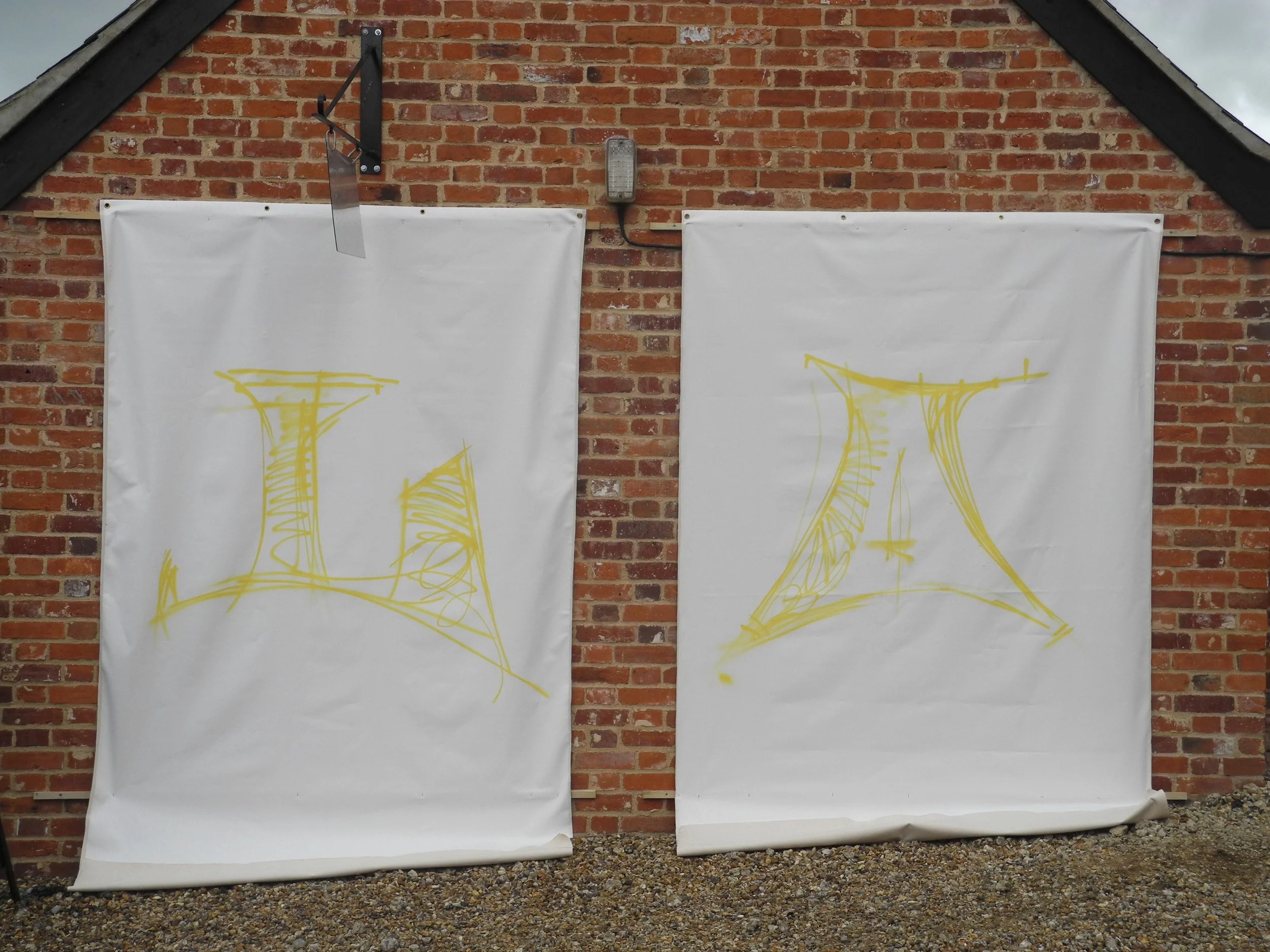
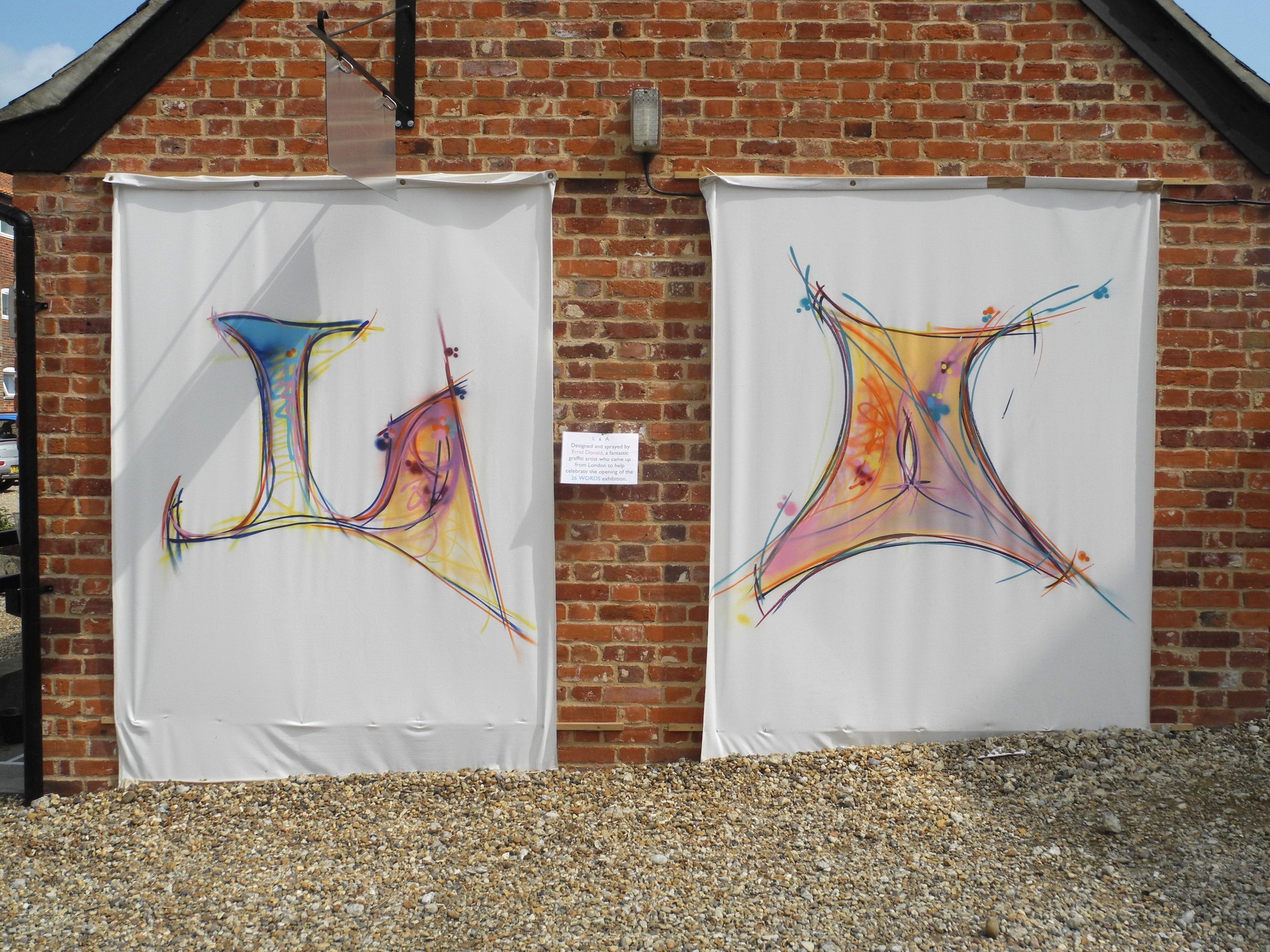
I was assigned the letters L and A for Lettering Arts, which not only worked nicely as a graphic pairing, but also made sense in representing language, line, action, and arrival, forming a dialogue that sits between form and freedom, between process and possibility. I took this as an invitation to explore mark-making as a conversation between intention and impulse.
By the time of the project, my own journey with graffiti had evolved. I had stepped away from painting walls and into more formal spaces; galleries, design projects, and community settings, but the instinct that first drew me to graffiti still coursed through everything I did: the joy of writing, of shaping letters by hand, of claiming space through scale, movement, and colour.
Graffiti art, for many, sits within the continuum of human mark-making, from cave walls to calligraphy, from ancient inscriptions to the digital screen. At its core lies a belief that a mark made by hand carries something irreducibly human. Even when stylised or wild, it’s still a form of communication, a way of saying, I am here.
That was my starting point when I arrived at the exhibition site. My space was the end wall of the Lettering Arts Centre where two large canvases had been set up. It was semi-sheltered, open enough for ventilation but away from the main flow of visitors. The brief was simple: respond to the exhibition theme, bring my own language to it and let the process unfold.
I began painting with my usual sense of freedom and exploration. Live painting always feels a little like performance, part concentration, part improvisation. There’s the release of the aerosol, the scent of paint in the air, the rhythm of pacing back and forth gauging how the forms begin to breathe on the surface. About an hour in, I noticed someone watching me from a distance, a woman, curious but hesitant. I waved a hello to show that she was welcome to come closer. She did, and we began to talk.
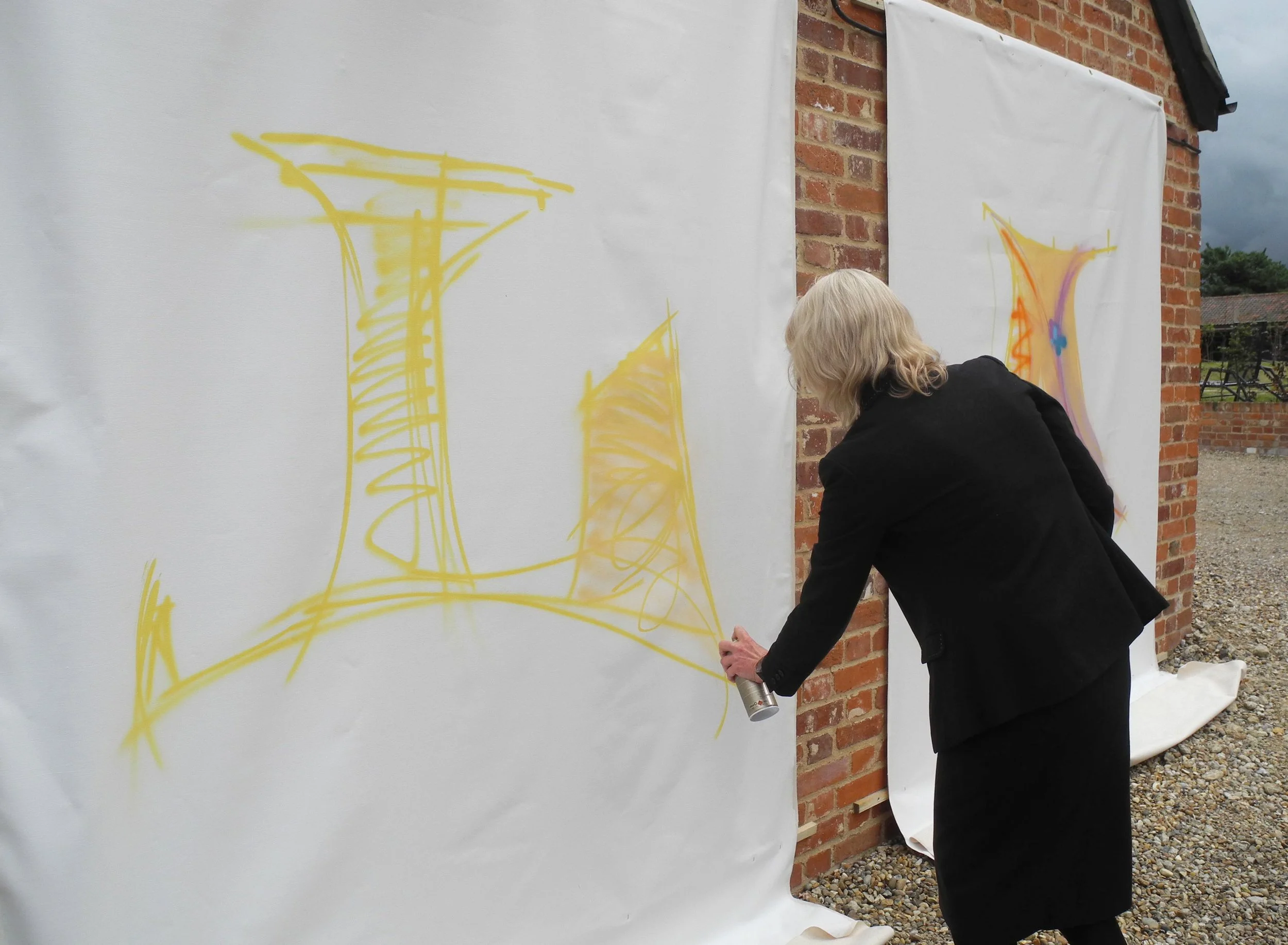
That’s often the way with live work. A passer-by becomes a witness, then a participant, and sometimes, if the moment allows, something more. I invited her to use a colour of her choice in adding to my first painting, which although a small gesture, either sparks surprise – or trepadation. She tentatively accepted, and added a few modest marks to the canvas. There was a sense of joy, shortly followed by a personal disclosure; she shared that her daughter had been passionate about art and design, and that she would have loved to try something like this.
She then spoke briefly about her daughter’s recent passing. For a few minutes, the conversation became something else, not about graffiti or art, but about bereavement, loss, and the strange ways we find to remember those who are gone. Her daughter’s name began with the letters L and A.
Neither of us could have anticipated that encounter. It was spontaneous, intriguing, and deeply human. For a while, time paused as our words drifted into the mist of paint being dispersed by the light breeze. When we parted, I felt both humbled and grateful, aware that what had just taken place was, in some way, part of the artwork itself.
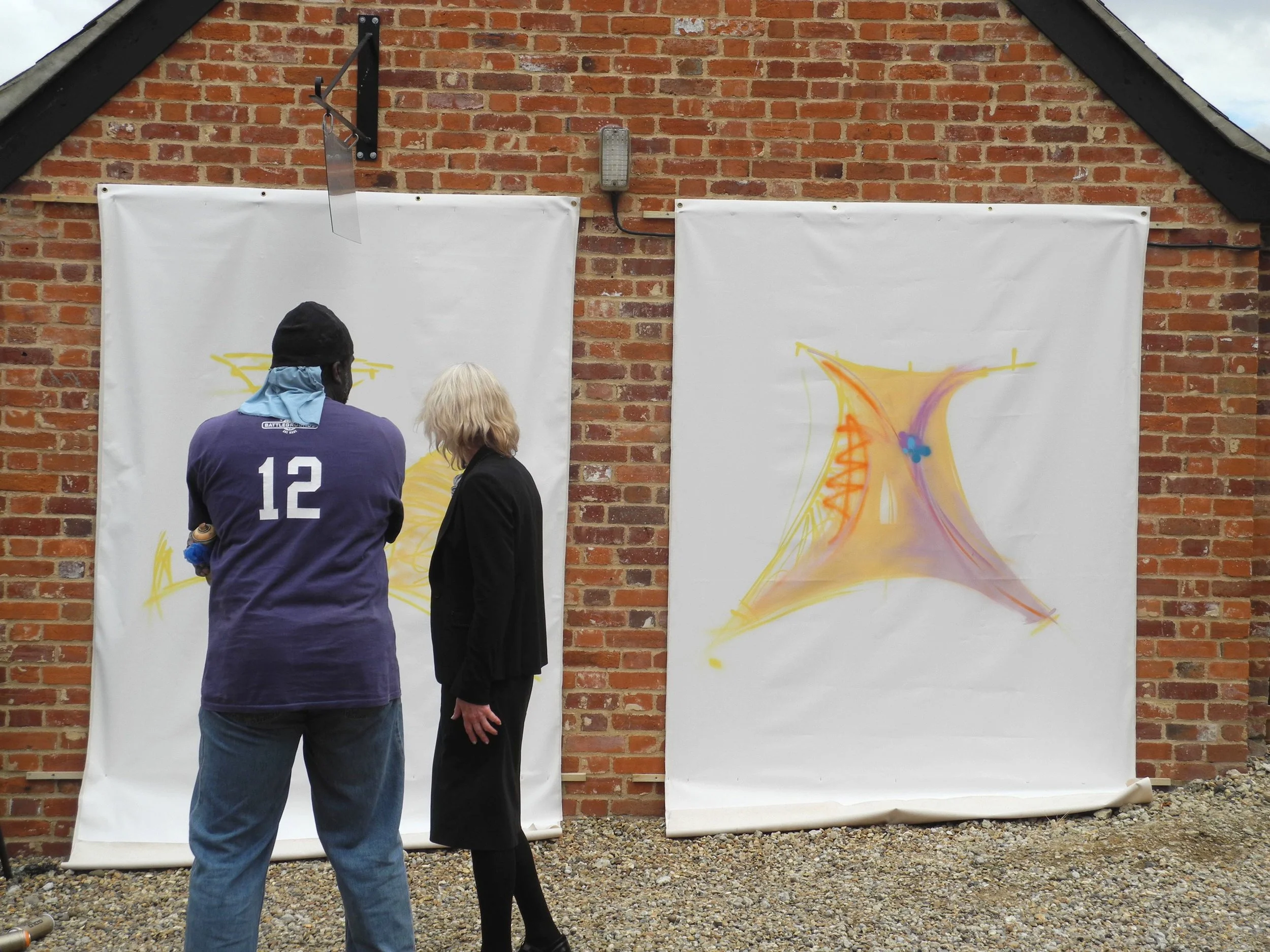
As I returned to painting, the experience stayed with me. My movements felt slower, more reflective, as if the act of painting had become a meditation on presence and memory. Graffiti is usually framed by energy and immediacy, yet that moment added another layer rooted in empathy and stillness.
What struck me most afterwards was how this brief, unscripted connection mirrored the nature of graffiti itself. Both are fleeting and exposed; both exist in the moment, unrepeatable. The spray-painted mark, like a conversation, begins with intention but finds its meaning only through encounter, through the response of others.
Graffiti’s impermanence is often seen as a weakness, but I’ve come to see it as its strength. Each mark made in public space acknowledges time’s passing; it asserts life against erasure, while accepting that nothing lasts forever. Like memory, it fades. What remains is the trace, a sign that something happened, that someone was here, that something was said.
Throughout the afternoon, I thought about memorials, and how people use words and letters to embed meaning. Names carved in stone, handwriting preserved in old sketchbooks, the looping flourishes of a tag on a wall, all attempt to bridge presence and absence. Writing is resistance; painting is to feel alive.
There’s also courage in that act, the willingness to make a mark without knowing how it will be received. That, to me, is what artists and writers share, whether carving letters into slate or painting them on canvas or trains. It’s the practice of showing up, of risking connection.
Looking back, I realise the 26 Words project offered more than a platform for creative exploration. It became a moment to reflect on purpose, to search for meaning within my practice, beyond skill or presentation. Graffiti has always been about voice; the voice of those rarely invited into the gallery, the lecture theatre, or the canon. But it’s also about empathy, the recognition that every mark, no matter how bold or rough, comes from a human hand, guided by feeling.
That day, between the movement of paint and the pause of conversation, I noticed the rhythm that connects us, the cycle of making and letting go, of speaking and listening, of legacy and appreciation. When I think back to that afternoon, what stays with me is not the finished canvases, but the encounter itself, spontaneous, fleeting, alive: a moment of connection made visible.
Errol Donald is an artist, designer, and wellbeing practitioner. He is also a Trustee of the Lettering Arts Trust.
Errol has curated exhibitions and hosted talks and screenings that share his passion for graffiti culture with new audiences, highlighting its influence on youth culture and the history of contemporary art.